Navigating Carry On Backpack Size Limits With Jet Ready Bag
 Jordan HaleStaff Writer
October 15, 2026. This exploration details the specific dimensions required for overhead bin compliance and how to select gear that meets these standards. It is written for frequent travelers who prioritize efficiency and avoiding gate-check fees.
Standing in a boarding line at O'Hare, I watched a gate agent slide a passenger's overstuffed bag into the metal sizing crate. The metallic thud as it failed to fit was a sound I had heard too many times. According to the Federal Aviation Administration (FAA), while they provide safety oversight, individual airlines are responsible for setting their own specific carry-on size limitations to ensure bags fit securely in overhead bins or under seats. This lack of a single universal standard creates a constant friction for travelers. Most major domestic carriers like American, United, and Delta typically gravitate toward a standard of 22 x 14 x 9 inches, but these measurements include handles and wheels. When you are choosing between a travel backpack vs suitcase for flights, the flexibility of the bag becomes your greatest asset. A rigid suitcase doesn't compress, but a soft-sided backpack can often be squeezed those last few millimeters to clear the sizer. The stress of the "will it fit" gamble defines the modern boarding process, turning what should be a simple transition into a calculation of volume and physics. It turns out that even a half-inch of protrusion can result in a fifty-dollar gate-check fee and a twenty-minute wait at the luggage carousel upon arrival.
Photo by Julia Filirovska on Pexels
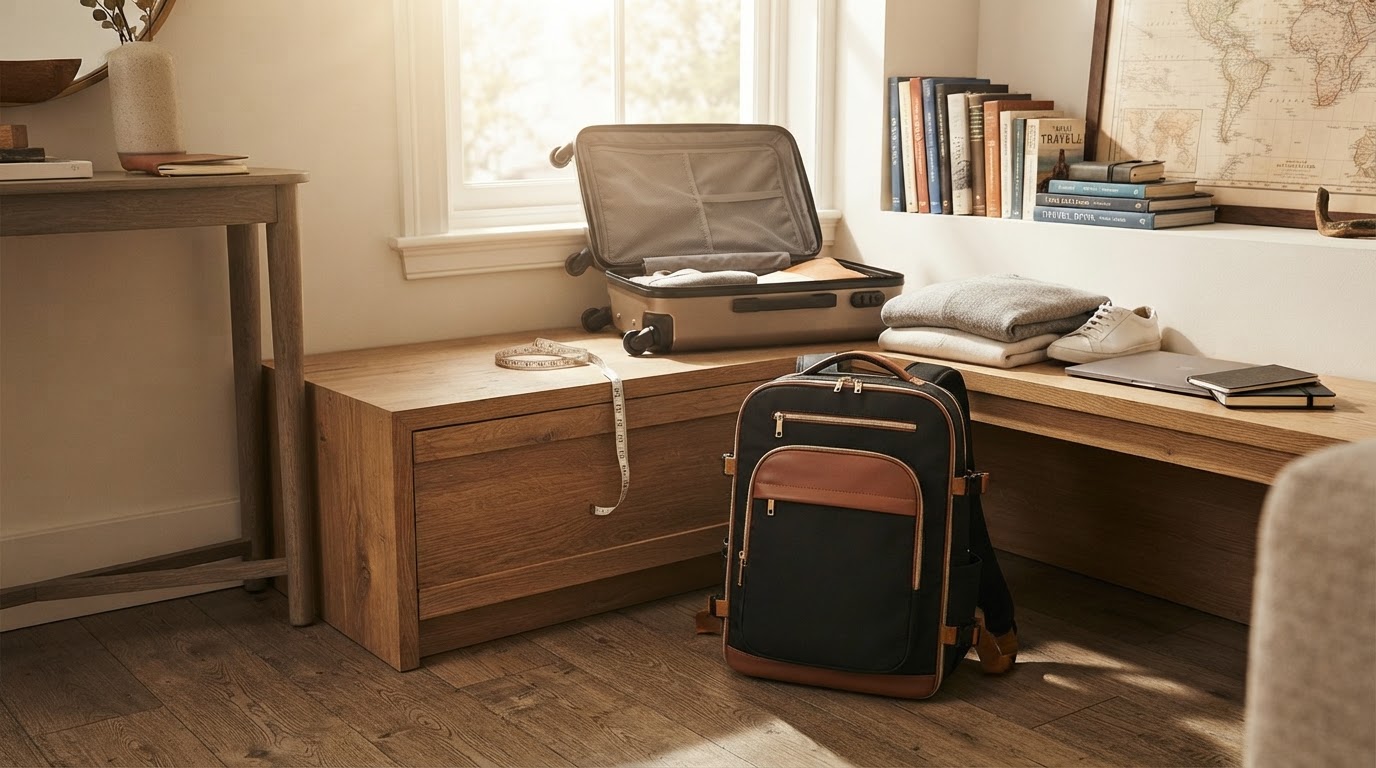
The first thing I noticed was the structured yet forgiving silhouette of the Jet Ready Bag. It is engineered to maximize the internal capacity while strictly adhering to the common 22-inch height limit that defines most overhead compartments. Because the bag lacks the protruding external wheels of a traditional roller, every inch of that limit is dedicated to actual packing space. When navigating security, the tsa friendly travel backpack features guide highlights how important it is for a bag to remain organized even when it is packed to its limit. The Jet Ready Bag uses a specific depth profile that prevents the "turtle shell" effect—that bulging shape that often causes backpacks to be flagged by gate agents for being too deep. By maintaining a slim profile even when full, the bag slides into the overhead bin lengthwise, satisfying the requirements of both domestic and many international carriers. For those flying on regional jets with smaller bins, the ability to transition the bag into a personal item backpack for flying by utilizing the compression straps is a critical advantage. I keep coming back to the way the straps tuck away, preventing the bag from snagging on the bin housing, a common issue that leads to frustrated flight attendants and delayed boarding. The design ensures that whether you are using it as your primary luggage or a secondary personal item backpack for flying, the external dimensions remain predictable and compliant.
Choosing the right gear requires a framework that accounts for the most restrictive airlines you plan to fly. While a bag might pass on a large Boeing 777, it may struggle on a regional Embraer. To ensure your Jet Ready Bag remains compliant across your entire itinerary, consider this decision framework:
- Verify the most restrictive segment of your journey, usually the regional or international connection.
- Utilize internal compression cubes to prevent the bag from bulging past the 9-inch depth limit.
- Check that all external straps are tightened and tucked to maintain a clean profile for the sizing crate.
- Measure the bag while fully packed, as soft-sided bags expand differently based on contents.
- Confirm the weight limits, as international carriers often weigh carry-ons even if they meet size dimensions.